Building Future-Ready Skills: Yenchi Wang’s AI Journey at PACE
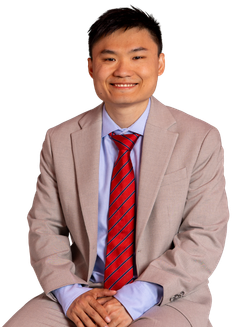
Yenchi (Louis) Wang came to Canada from Taiwan with a clear goal to gain hands-on experience in the field of Artificial Intelligence and build a future-ready career. Choosing the PACE AI program at The University of Winnipeg was a strategic step toward that goal.
At PACE, Yenchi experienced a learning environment that emphasized practical, industry-relevant skills. He learned directly from instructors who are active professionals in the field, gaining exposure to key areas such as data analysis, Python programming, cloud computing, and machine learning. Through this hands-on approach, he developed the confidence to apply these skills across different industries, not just within AI.
One of the most valuable aspects of Yenchi’s experience was the opportunity to practice and refine his skills in real-world scenarios. Working closely with instructors and peers helped him become comfortable solving complex problems and adapting to industry expectations. This practical foundation prepared him to transition smoothly into the workforce.
After graduating, Yenchi began his career as a Digital Solutions Lead at Freedom Concepts, a company that designs customized bicycles for individuals with unique needs. In his role, he applies the skills he developed at PACE working on data analysis, building workflows, and improving enterprise systems—demonstrating how versatile and transferable AI skills can be.
Yenchi reflects on his time at PACE as a strong starting point for building a career in Canada’s technology sector. His advice to future students is to stay open to learning, actively engage with hands-on opportunities, and use the program as a foundation to explore diverse career paths. For him, PACE was more than an academic experience—it was the beginning of a meaningful professional journey.
Building Confidence and Career Readiness: Paola Romero’s Project Management Journey at PACE
Paola Romero joined The University of Winnipeg PACE to pursue the Project Management program with a goal of strengthening her professional skills and advancing her career. What she found at PACE was more than an academic experience—it was a journey that built her confidence and prepared her for success in the Canadian workplace.
One of the most impactful aspects of Paola’s experience was learning from industry professionals. Her instructors brought real-world knowledge into every class, helping her understand how to apply theoretical concepts in practical work environments. This approach made learning engaging, relevant, and directly aligned with the expectations of today’s workforce.
Beyond the classroom, Paola benefited from the strong support systems at PACE. Writing tutors helped her refine her communication skills, while career services provided guidance on building a professional resume, crafting an effective elevator pitch, and improving presentation abilities. These resources played a key role in helping her align her experience with Canadian market standards and present herself with confidence.
Paola also valued the diverse and collaborative learning environment at PACE. Working alongside classmates from different countries allowed her to gain new perspectives, strengthen her teamwork skills, and better understand cross-cultural communication—an essential skill in project management. She further expanded her professional network by participating in industry events and engaging with the Project Management Institute, which supported her goal of becoming a certified professional.
Today, Paola works as a Safety & Health Officer with the Government of Manitoba, applying the skills and knowledge she developed at PACE in a meaningful and impactful role. She credits her success to the practical learning, supportive community, and strong professional connections she built during her time at PACE.
Her advice to future students is to take full advantage of every resource available, stay proactive, and build meaningful connections. For Paola, PACE was not just about gaining knowledge—it was about discovering her potential and building a path forward.
From Student to Senior Software Engineer: How PACE Helped David Tobar Build His Tech Career
When David Tobar enrolled in the Web Application Development program at The University of Winnipeg PACE, he was looking for a program that combined practical skills with strong support for international students. What he found exceeded his expectations. Through hands-on projects and real-world assignments, David learned to work in teams and tackle software challenges that closely mirrored actual industry work. The instructors, who came from diverse professional backgrounds, provided practical knowledge that extended far beyond textbooks.
David’s experience was also shaped by the strong support network that PACE offers international students. He highlights how writing services, career coaching, and guidance from the career services team helped him navigate the Canadian job market and build confidence. In addition to technical training, PACE provided David with valuable career tools, including job search preparation, interview coaching, and resume guidance. Working closely with classmates from different countries also helped him develop strong teamwork and communication skills.
Today, David is a Senior Software Engineer at Techie Talent, where he applies the same real-world coding and teamwork experience he built at PACE. His advice to future students is simple: take the leap. The program, the university, and the career services are all designed to help you succeed both in your studies and your career.
Bridging Theory and Practice: Shane’s Journey as a Project Management Student at PACE
Tzu-Lin (Shane) Ho is a graduate of the Project Management program at The University of Winnipeg PACE, and their experience in the program was both practical and transformative. Shane entered the program with curiosity and a strong desire to grow and quickly discovered that PACE’s learning model offered far more than traditional instruction. Learning from instructors with real industry experience allowed Shane to connect academic concepts to real-world situations through practical examples and case studies. This approach provided a deeper understanding of how project management principles are applied in professional settings.
One of the most valuable aspects of Shane’s journey at PACE was the opportunity to collaborate with classmates from around the world. Studying in a multicultural environment helped Shane develop the ability to communicate effectively, manage cross-cultural teams, and build inclusive working relationships, skills that are essential for today’s project management professionals. Beyond technical learning, the program also supported Shane in refining their resume, strengthening interview skills, and building confidence to navigate Canadian workplace culture.
Today, Shane is applying these skills in their role as a Project Coordinator at the Canadian Immigrant Professional Alliance, where they continue to grow professionally. They credit their readiness for the workforce to supportive instructors, a practical learning approach, and meaningful connections formed during their time at PACE. Shane’s advice to future students is to step out of their comfort zone, stay engaged with the community, and take advantage of every opportunity to learn and connect because those experiences can open doors long after graduation.
From Student to Specialist: How PACE Helped Suchini Fernando Launch Her IT Career in Canada
When Suchini Fernando arrived at PACE, she brought with her a solid background in IT but knew that transitioning to Canada’s job market would require more than technical knowledge.
That’s why she enrolled in the Project Management Diploma at PACE, and it changed everything.
“PACE offered more than just academics. It gave me the space to collaborate, learn about Canadian workplace culture, and grow beyond the classroom.”
Suchini highlights the role of her instructors whom she refers to as coaches as being instrumental in her growth. From resume-building sessions to pitch workshops and presentation coaching, every component prepared her to position her experience for Canadian employers.
“They told us from day one to build our network and that became my top priority. It worked. I landed a job from my first interview before I even finished the program.”
She now works as a Senior Software Quality Assurance Specialist at Pollard Banknote, and credits PACE for helping her make a smooth transition into the workforce.
Her advice to future students?
“Think ahead. Set realistic goals. Build your network. And always follow up. That’s how even the impossible becomes possible.”
“PACE offered me both personal and professional development in ways I never imagined,” says Nadine King, a proud graduate of the Project Management Diploma program in 2020.
Nadine, originally from Jamaica, entered PACE with over a decade of experience in leadership roles, but she knew she needed to deepen her knowledge of project management to further her career in Canada. "The diversity in the classroom made me feel like I was in 16 countries all at once, and that was just the beginning of how amazing the experience was."
The Project Management Diploma program at PACE not only connected Nadine with fellow students from all over the world but also provided real-world insights from instructors who were active professionals in the industry. "What set PACE apart was the practical knowledge the instructors shared. They weren’t just teaching from textbooks—they brought in their own experiences from the field, which helped us relate to real-world situations."
Nadine transitioned from student to professional in no time. Today, she works as a Branch Manager at CIBC, a position she secured soon after graduation. "Although the program only lasted a year, it felt like five years' worth of experience packed into one. The professors were not just teachers; they were coaches, helping guide us through our journey," she says.
What makes Nadine’s story even more inspiring is that she has returned to PACE, now serving as an instructor. “I still feel like part of the PACE family,” Nadine shares. “I would tell anyone considering the program to take that bold step. You won’t regret it. PACE makes you feel like part of an elite professional group.”
Drive Continuous Improvement with Lean Methodologies
Organizations across every industry are looking for professionals who can improve processes, reduce waste, and deliver measurable results. Lean methodologies provide a proven framework for increasing efficiency, improving quality, and creating greater value for customers.
The Lean Yellow & Green Belt Training Program equips professionals with the practical knowledge and tools needed to lead continuous improvement initiatives in manufacturing, healthcare, government, education, and service organizations.
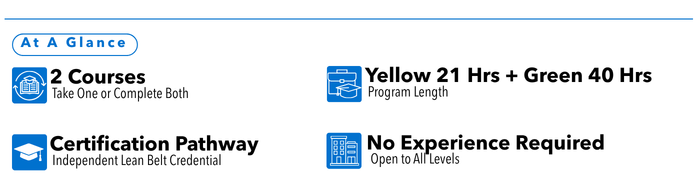
Participants begin by developing a strong foundation in Lean principles, process mapping, workplace organization, waste reduction, and problem-solving through the Lean Yellow Belt course. The Lean Green Belt course builds on these skills with advanced process improvement methodologies, project leadership, data-informed decision-making, and the application of Lean tools to complex organizational challenges.
Courses may be taken individually or as a progressive learning pathway. Upon successful completion, participants will be well prepared to pursue professional Lean Belt certification through an independent certifying body.
This program is ideal for professionals who want to improve organizational performance by reducing waste, streamlining processes, and leading continuous improvement initiatives.
Typical participants include:
Supervisors, managers, and team leaders
Project managers and project coordinators
Business analysts and process improvement specialists
Operations, manufacturing, logistics, and supply chain professionals
Healthcare, government, education, and service-sector professionals
Quality assurance and continuous improvement practitioners
Professionals preparing for Lean Belt certification
No previous Lean experience is required to begin the Lean Yellow Belt course.
The Lean Yellow & Green Belt Training Program develops the practical skills needed to improve processes, eliminate waste, and support continuous improvement initiatives.
Throughout the program, participants will learn to:
Apply Lean principles to improve organizational performance.
Analyze business processes and identify improvement opportunities.
Use structured problem-solving and root cause analysis techniques.
Apply Lean tools including value stream mapping, 5S, and visual management.
Support and lead continuous improvement initiatives.
Prepare for professional Lean Belt certification.
Outcomes
Upon successful completion of the program, participants will be able to:
Explain the principles and philosophy of Lean methodology.
Identify waste and opportunities for process improvement.
Apply Lean tools to analyze and improve operational and service processes.
Develop process maps, SIPOC diagrams, and value stream maps.
Apply structured root cause analysis techniques.
Prioritize improvement opportunities using data-informed decision-making.
Support and lead Kaizen events and Lean improvement projects.
Apply workplace organization principles including 5S and standardized work.
Prepare for independent Yellow Belt and Green Belt certification requirements.
Completion of the University of Winnipeg Lean Yellow & Green Belt Training Program prepares participants for professional Lean Belt certification but does not itself confer Yellow Belt or Green Belt certification.
Professional certification is awarded separately by an independent certifying body after participants successfully complete the required training, examination, and applied practice requirements.
Yellow Belt Certification Requirements
To earn Yellow Belt certification, participants must:
Successfully complete Lean Yellow Belt training
Achieve a minimum score of 70% on the certification examination
Participate in a Continuous Improvement Event
Certification fee:$450 (paid directly to the certifying body and not included in tuition)
Green Belt Certification Requirements
To earn Green Belt certification, participants must:
Successfully complete Lean Green Belt training
Achieve a minimum score of 70% on the certification examination
Complete a DMAIC project or Continuous Improvement Event
Certification fee:$550 (paid directly to the certifying body and not included in tuition)
Build the Skills to Successfully Manage Construction Projects
Construction projects require specialized project management expertise that goes beyond traditional project management principles. From procurement and contracts to safety, scheduling, budgeting, and risk management, today's construction professionals must balance technical knowledge with strong leadership and decision-making skills.
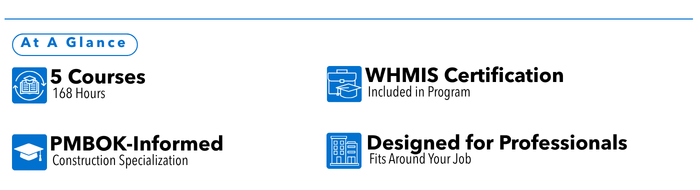
The Construction Project Management Certificate prepares professionals to successfully manage construction, infrastructure, and capital projects by combining recognized project management best practices with construction-specific knowledge and emerging industry trends. Through applied learning, students develop the practical skills needed to plan, execute, monitor, and close construction projects while managing contracts, costs, stakeholders, safety, and project risks.
Designed for professionals with prior project management or construction experience, this flexible online certificate provides the specialized knowledge needed to confidently lead construction projects across public and private sectors.
For more information regarding tuition & fees and payment options, click here.
Please budget approximately $400 for textbook costs. Textbook costs may vary depending on new, rental, used, or electronic purchasing choices. Textbooks are a requirement.
Costs may vary depending on mode of course delivery and are subject to change.
This certificate is ideal for professionals with project management or construction experience who want to specialize in managing construction projects.
Typical participants include:
Project managers and project coordinators
Construction supervisors, site leads, and forepersons
Estimators, schedulers, and cost-control professionals
Engineers, engineering technologists, and skilled trades professionals
Graduates of project management diploma or certificate programs
Professionals working with contractors, consultants, municipalities, or infrastructure projects
The Construction Project Management Certificate develops the specialized knowledge and practical skills needed to successfully manage construction projects from planning through completion.
Throughout the program, students will learn to:
Apply project management principles within construction environments.
Plan and manage construction schedules, budgets, and project resources.
Manage procurement, contracts, and vendor relationships.
Identify and mitigate construction-specific risks.
Develop communication strategies for project teams and stakeholders.
Apply industry best practices related to construction safety, quality, and project delivery.
Outcomes
Upon successful completion of this certificate, graduates will be able to:
Develop and execute comprehensive construction project plans.
Define project scope, schedules, budgets, and resource requirements.
Apply procurement and contract management principles within construction projects.
Develop communication plans that support effective stakeholder engagement.
Identify project risks and implement mitigation strategies.
Manage project scope changes while protecting organizational objectives.
Apply construction project management best practices throughout the project lifecycle.
Graduation from the Project Management Diploma, Advanced Project Management and Technology Diploma, Applied Project Management Certificate, or an equivalent credential;
OR
A minimum of one year of construction industry experience.
Build the knowledge and confidence to lead AI adoption responsibly within your organization.
The Ethical AI for Business Leaders Microcredential is designed for professionals who want to understand the opportunities, risks, and practical applications of artificial intelligence in today's workplace. Through interactive discussions, hands-on exercises, case studies, and real-world projects, you'll learn how to leverage ChatGPT and other AI tools to improve productivity while making informed, ethical decisions about their implementation.
By the end of the microcredential, you'll have the practical skills to evaluate AI technologies, develop effective prompting techniques, understand governance and ethical considerations, and confidently integrate AI into business processes.
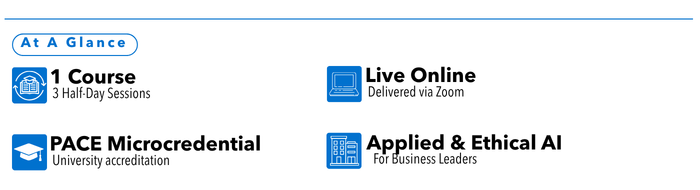
The Ethical AI for Business Leaders Microcredential consists of three half-day online sessions delivered live via Zoom for a total of 9 instructional hours.
Earn a University of Winnipeg PACE Microcredential
Upon successful completion of the microcredential, you can apply to receive the Ethical AI for Business Leaders Microcredential.
This credential recognizes your ability to evaluate, implement, and govern AI technologies responsibly while applying ethical decision-making in today's rapidly evolving business environment.
Organizations today face constant transformation, from digital initiatives and organizational restructuring to new technologies and evolving ways of working. Successfully navigating change requires more than project management; it requires leaders who understand the human side of change.
The Leading Change Management Certificate equips professionals with the practical skills and strategic insight needed to lead successful organizational change initiatives. Built on contemporary change management theories and informed by current industry practices, the program focuses on helping individuals, teams, and organizations successfully adopt and sustain change.
Through applied learning and real-world case studies, you'll develop practical skills in stakeholder engagement, communication planning, organizational readiness, resistance management, leadership, and change execution. You'll also explore emerging trends, including digital transformation, artificial intelligence, and other evolving technologies, and their impact on today's workplace.
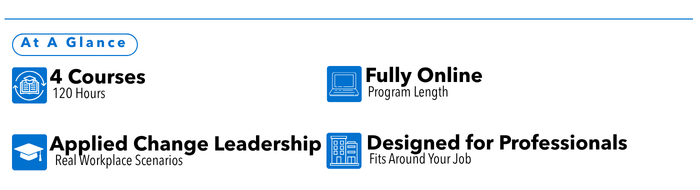
Delivered fully online in a flexible, part-time format, this 120-hour certificate includes three core courses and a specialized seminar focused on emerging technologies.
For more information regarding tuition & fees and payment options, click here.
Please budget approximately $400 for textbook costs. Textbook costs may vary depending on new, rental, used, or electronic purchasing choices. Textbooks are a requirement.
Costs may vary depending on mode of course delivery and are subject to change.
The Leading Change Management Certificate develops the practical skills, strategic mindset, and leadership capabilities needed to guide organizations through continuous change.
Throughout the program, students learn to:
Assess organizational readiness for change.
Develop and implement structured change management strategies.
Engage leaders, employees, and stakeholders throughout change initiatives.
Address resistance and reinforce sustainable adoption.
Align change initiatives with organizational objectives.
Evaluate the impact of emerging technologies on organizational change.
Apply ethical decision-making to modern workplace challenges.
Outcomes
Upon successful completion of this certificate, graduates will be able to:
Analyze workplace situations using established change management theories and models.
Apply structured methodologies to plan, implement, and evaluate change initiatives.
Assess organizational readiness and identify barriers to successful change.
Develop communication and stakeholder engagement strategies that support adoption.
Evaluate organizational capabilities that contribute to successful transformation.
Examine the opportunities, risks, and ethical implications of emerging technologies.
Support leaders and teams through organizational change with confidence.
Be a high school graduate or hold a Mature Status Diploma.
MUST provide High School Transcript or recognized equivalent GED or Mature Grade 12 Diploma.
OR
Be 18 years of age or older and have completed 90 hours of coursework or more at a recognized post-secondary institution (including UWPACE) with minimum cumulative GPA of 2.5 or higher.
MUST provide an official transcript for all previous post-secondary study (including university, CEGEP, or private college).
English Language Requirement
Applicants whose previous education was completed outside of Canada and where English may or may not have been the medium of instruction, must submit proof of meeting one of the accepted English language proficiency measures. Download the UWPACE English Language Requirements (PDF) for additional English proficiency tests and programs and waiver options for the English language requirement.
By clicking "Accept" you allow cookies that improve your experience on our site, help us analyze site performance and usage, and enable us to show relevant marketing content.











Learn more about Online Education here.